
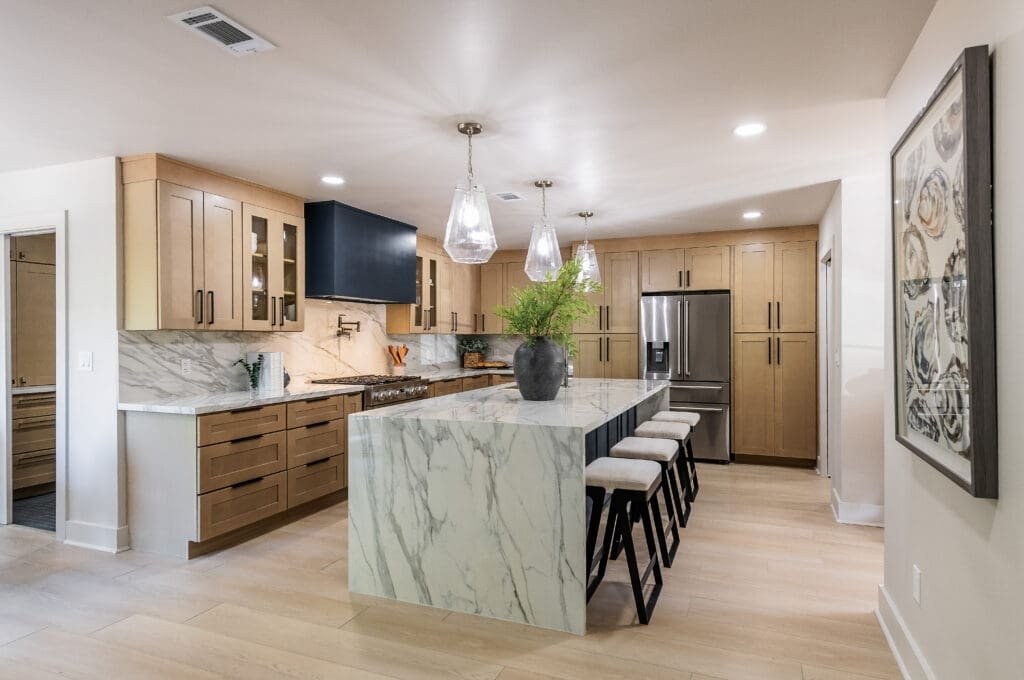
When homeowners visit our Alpharetta showroom to pick their dream countertop, they often focus on choosing the perfect color and pattern. But there’s another important choice that shapes your kitchen or bathroom just as much: the countertop edge profile. This detail affects not only how your space looks but also how it works every day. Choosing the right edge makes a big difference.
Quick Answer: How to Choose a Countertop Edge Profile
Edge profiles affect style, safety, cleaning, and budget just like color or material. The shape along your countertop’s visible edge can turn a simple slab into a statement piece or keep things simple and practical, depending on your needs.
Here are the most common edge profiles we offer at Granite & Marble Solutions:
- Eased – softened square corners, our most popular choice
- Square (Straight) – clean, crisp lines with safety micro-beveled edges
- Bevel – angled cut that catches light and adds subtle detail
- Half Bullnose – rounded top with flat underside
- Full Bullnose – fully rounded top and bottom
- Ogee – decorative S-shaped curve for an elegant look
- Mitered/Flat – joined pieces creating a thicker, solid appearance
- Waterfall – countertop that extends downward to the floor
Matching edge profile to lifestyle:
- Families with kids or pets → Choose eased or bullnose edges with slightly rounded corners for safety
- Cooks who use heavy cookware → Pick simpler, chip-resistant profiles like eased or half bullnose
- Showpiece islands → Consider ogee or waterfall edges for dramatic style
Our design team in Alpharetta guides homeowners and contractors through edge choices during free consultations. Most projects are installed within 7 business days after template approval.
Tip: If unsure, choose eased or half bullnose edges. These profiles offer safety and timeless style that work with many design styles and materials.
What Is a Countertop Edge Profile?
A countertop edge profile is the finished shape of the outer rim of your countertop. You see and touch it every time you stand at your kitchen sink or lean on your island.
Edges can be straight, softly rounded, fully curved, or ornate with curves and steps, depending on your countertop material and style.
Practical roles of edge profiles:
- Safety – Rounded edges reduce sharp corners that can hurt kids or snag clothes
- Cleaning – Simple shapes stop crumbs and spills from collecting in grooves
- Durability – Some profiles resist chipping better under daily use
- Cost – More detailed edges take more time and skill, affecting price
Natural stones like granite, marble, and quartzite allow detailed edge types. Engineered surfaces like quartz and porcelain work best with certain shapes. Our fabricators help you choose edges that fit your slab perfectly.
Think of the edge as a frame for your countertop. The right profile highlights patterns in marble, quartz, or granite, making the stone’s beauty stand out.
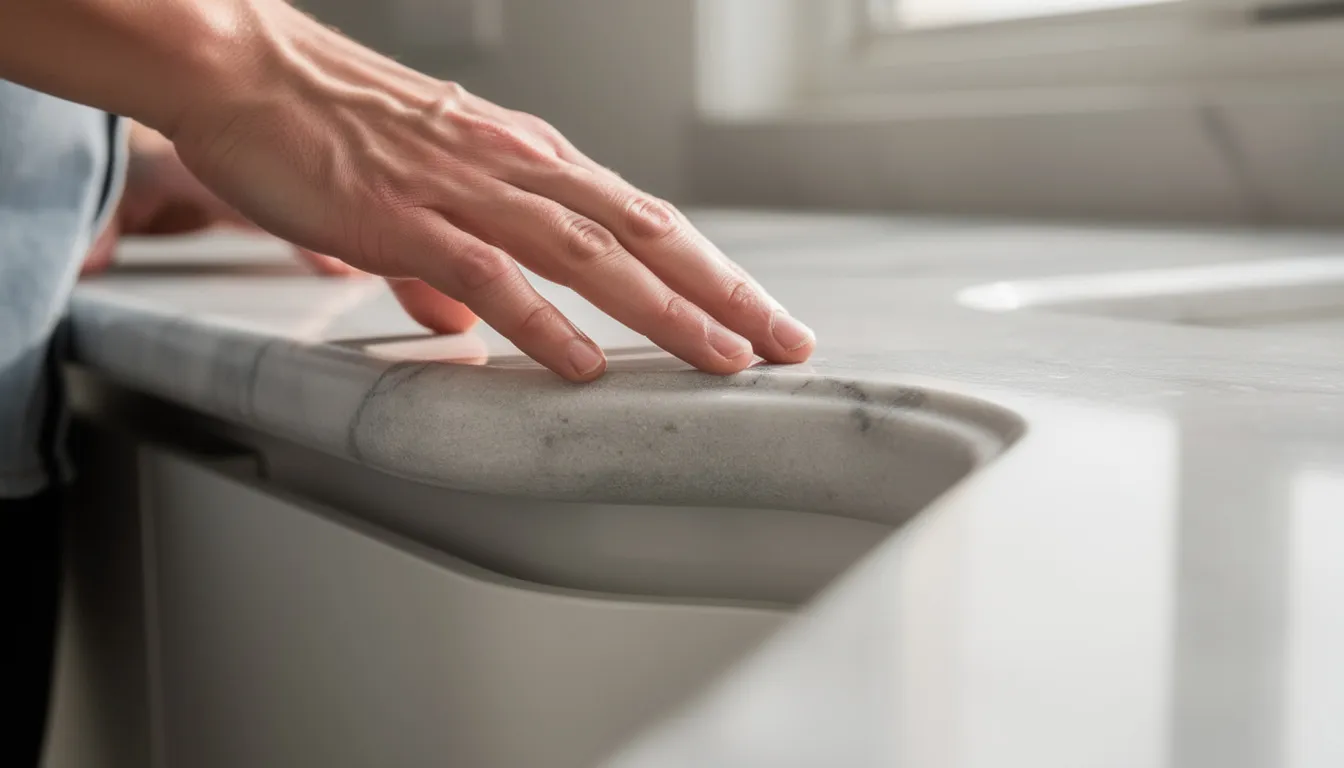
Popular Countertop Edge Profiles
Here are the popular countertop edge profiles most North Metro Atlanta homeowners and contractors pick for kitchens, bathroom vanities, and commercial spaces.
Each section below explains what the edge looks like, which materials it suits (granite, quartz, marble, quartzite, porcelain), ideal design styles, and practical pros and cons. We use real examples from Granite & Marble Solutions projects and local remodels.
Square (Straight) Edge
The square edge is clean and straight with crisp lines. We add a tiny bevel on corners for safety—no sharp 90° angles, just a sleek, modern look with safety in mind.
This flat edge fits modern and contemporary styles, especially on quartz and porcelain paired with flat-panel cabinets.
Benefits:
- Sleek look that highlights the slab
- Works with both thin (2cm) and thick (3cm) tops
- Pairs well with waterfall ends for a seamless look
- Usually budget-friendly
Considerations: Corners can feel sharper than eased or bullnose edges. Chips may show more on some materials if hit hard.
Example: A Roswell condo kitchen used 2cm white quartz with a square edge for a minimal, European style.
Eased Edge
The eased edge is a softened square with slightly rounded corners. It’s our most popular profile for granite and quartz in North Metro Atlanta.
Safety and comfort: The gentle rounding is less likely to catch clothes or scratch skin. Great for homes with kids in areas like Cumming and Alpharetta.
Easy to clean: The simple shape wipes down easily with no grooves for crumbs or spills.
Durability: Fewer fragile points than ornate edges, making it smart for busy kitchens and rentals.
We often suggest the eased edge as a starting point for undecided homeowners. It fits nearly any kitchen style and keeps your space practical.
Beveled (Bevel) Edge
The beveled edge cuts the top corner at a 45-degree angle, catching light and adding subtle detail without being too fancy.
This timeless edge works well in traditional and transitional kitchens, especially on quartz and granite.
Benefits:
- Softer to touch than a square edge
- Makes the countertop look thinner and refined
- Reflects under-cabinet lighting nicely
- Easy to clean with no grooves
Bevel size can be small or larger for decoration. Visit our Alpharetta showroom to see samples in 2024.
Example: A double bevel on dark granite perimeter added depth against light shaker cabinets.
Bullnose & Half Bullnose Edges
The full bullnose edge is fully rounded on top and bottom for a soft curve. The half bullnose rounds the top but keeps a flat underside.
These edges are popular on granite and quartz in family-friendly kitchens, islands, and bathroom vanities.
Advantages:
- Very forgiving to bumps and impacts
- Safe for kids with no sharp corners
- Softens heavy stone like 3cm granite visually
- Great for traditional or classic kitchens
Note: Full bullnose can let spills roll off easily; half bullnose tends to keep spills on the surface.
Example: A 2023 Dunwoody kitchen used half bullnose on a granite island for comfort at the bar seating.
Ogee Edge
The ogee edge has an S-shaped curve with a concave dip flowing into a convex rise. It adds a decorative, furniture-like detail.
This premium edge is perfect for focal points like kitchen islands, buffets, and master bath vanities.
Benefits:
- Raises the look of marble and quartzite instantly
- Fits traditional and classic styles well
- Pairs with detailed cabinets and crown molding
- Creates a custom, high-end look
Trade-offs: More fabrication time means higher cost. The shape is delicate and needs extra care to stay crumb-free.
Example: A Roswell remodel featured a Calacatta-look quartz island with an ogee edge as the kitchen’s centerpiece.
Mitered / Flat Edge (Thickened Look)
A mitered edge joins pieces at a 45-degree angle to look like a thicker slab—e.g., 2cm quartz built up to look like 4cm.
Unlike a simple square edge, mitered edges focus on the front apron to create a bold, solid appearance.
Where it works best:
- Large kitchen islands
- Waterfall ends
- Modern bars needing a strong stone presence
Skilled fabrication is key to tight seams and pattern matching. Our 1-year craftsmanship warranty and in-house shop give peace of mind.
Example: A mitered 4cm edge on a porcelain island in Alpharetta gave a sleek, modern feel.
Waterfall Edge
A waterfall edge turns the countertop material downward along the island or cabinet side to the floor, often using mitered joints for a seamless look.
This bold design is common in modern kitchens and open homes around Atlanta.
Advantages:
- Shows off veining and pattern continuity on quartz or marble surfaces
- Anchors an island visually as a focal point
- Protects cabinet ends from damage
Cost and care: Needs more material and fabrication time. Best for engineered quartz and porcelain rather than fragile natural stones.
We recommend waterfall edges on one or two feature pieces, like an island, while keeping perimeter edges simpler for budget balance.
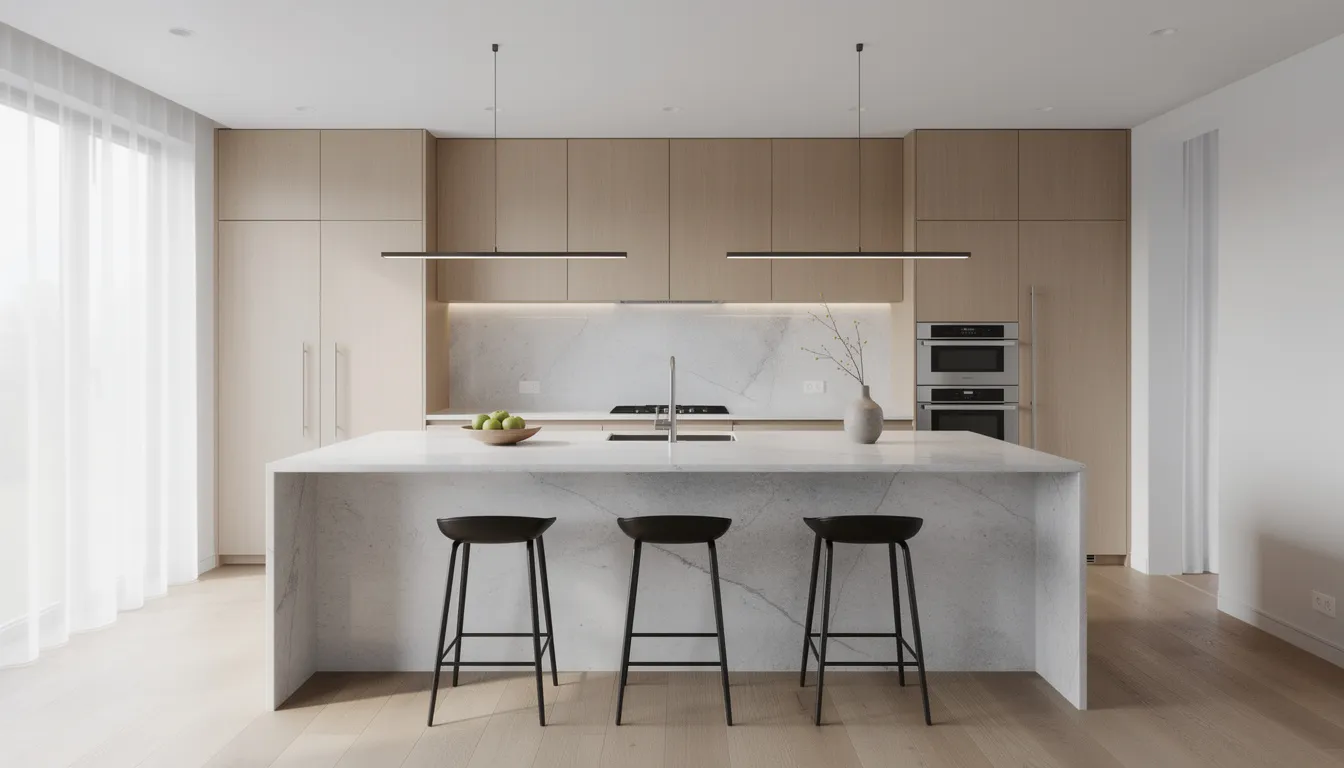
Matching Edge Profiles to Design Style
The same stone can look traditional, transitional, or ultra-modern just by changing its edge profile. This small detail affects your entire look.
Here’s how common edges match design themes in North Metro Atlanta homes:
| Design Style | Recommended Edge Profiles |
|---|---|
| Modern & Contemporary | Square, eased, mitered, waterfall |
| Transitional & Farmhouse | Eased, half bullnose, modest bevel |
| Traditional & Classic | Ogee, full bullnose, larger bevel |
Mixing edges—like ogee on the island and eased on perimeter counters—is common and balances beauty with practicality.
Modern & Contemporary Kitchens
Flat-panel cabinets, minimal hardware, and neutral quartz or porcelain surfaces pair well with square, eased, mitered, and waterfall edges.
Long, straight runs with few seams keep clean lines and show off edge thickness.
Examples:
- Square edge on matte black quartz with stainless steel appliances
- Waterfall island in marble-look quartz for an Alpharetta loft
Ornate edges like ogee can clutter these minimal spaces. Under-cabinet lighting highlights bevels and mitered edges nicely.
Transitional & Farmhouse Designs
These styles mix clean lines with subtle details. Eased, half bullnose, and modest bevel edges fit well.
Examples:
- Eased edge on white shaker cabinets with subway tile backsplash
- Half bullnose on warm granite with farmhouse sinks
These edges feel fresh but not stark, popular in Roswell and Dunwoody homes. Adding a slightly ornate edge on an island can give farmhouse kitchens a custom touch.
Traditional & Classic Kitchens
Raised-panel cabinets, decorative range hoods, and ornate lighting pair well with ogee, full bullnose, and large bevel edges.
These edges suit marble, quartzite, and rich granite patterns that feel luxurious.
Examples:
- Ogee edge on a dark-stained island with cream countertops
- Full bullnose on polished granite with detailed corbels
Keep in mind these edges cost more and need more cleaning care. Our designers help balance ornate and simple edges to fit your budget and style.
Edge Profiles & Material Compatibility
Not all edges work with every material. Hard stones handle detailed edges well, while softer materials need simpler shapes for durability.
We fabricate granite, marble, quartz, quartzite, and porcelain in-house, tailoring edge advice to your slab and use. Safety and longevity guide our recommendations.
Granite & Quartzite Countertops
These hard stones suit almost all edges: bullnose, ogee, bevel, mitered, and more.
Tips:
- Eased or half bullnose for everyday kitchens—balancing beauty and chip resistance
- Ornate edges like ogee work well on granite islands for a high-end look
- Quartzite supports thin, modern edges but simpler edges suit busy areas
Example: A quartzite waterfall island with mitered edges shows dramatic veining flowing to the floor.
Quartz Countertops
Engineered quartz is durable and fits many edges: square, eased, bevel, mitered, and waterfall.
Quartz’s consistent structure makes modern, linear edges very clean. Ogee and bullnose are possible but cost more.
For chipping concerns near sinks or dishwashers, eased or half bullnose adds strength.
Example: 3cm white quartz with eased edge in a busy Cumming kitchen offers easy cleaning and soft corners.
Marble Countertops
Marble is softer and chips more easily than granite or quartzite, so choose durable edges.
Suggestions:
- Simple edges like eased, half bullnose, or small bevel minimize delicate points
- Ogee is stunning but best for low-traffic areas like bathroom vanities
We guide clients on wear expectations for ornate marble edges.
Example: A honed marble vanity with eased edge in a Roswell bath creates a timeless, spa feel.
Porcelain & Ultra-Compact Surfaces
Porcelain slabs are thin and dense, needing special tools for clean edges without chipping.
Best edges:
- Square and eased edges
- Mitered edges for thick, modern aprons on islands
We avoid intricate edges like ogee on porcelain due to complexity and limited benefit. Our Alpharetta team makes seamless mitered corners for sleek solid surfaces.
Example: A porcelain waterfall island in a Dunwoody townhouse uses mitered edges for a furniture-like centerpiece.
Cost, Durability & Maintenance Considerations
Edge profiles affect your project cost and how your counters perform daily.
Simple edges (eased, square, small bevel) usually cost less and last longer. Ornate edges (ogee, multi-step) cost more and need more care.
Key points:
- Fabrication time – Complex edges take more skilled labor and time
- Chipping risk – Sharp or intricate edges chip more easily
- Cleaning ease – Smooth edges prevent dirt buildup; grooves can trap crumbs
Granite & Marble Solutions provides clear pricing so Atlanta homeowners see how edges affect their quote. Our 1-year warranty covers fabrication issues for peace of mind.
How Granite & Marble Solutions Helps You Choose the Right Granite Edges
Most homeowners don’t choose countertop edges often, so we make selecting the right granite edges easy with samples, displays, and photos in our Alpharetta showroom.
Our process includes:
- Free consultation to learn your style, lifestyle, and budget
- Expert advice on the best Edge for your granite kitchen or bathroom
- Digital templating for precise measurements
- In-house fabrication with detailed quality checks
- Professional installation, usually within 7 business days after template approval
We serve Alpharetta, Cumming, Roswell, Dunwoody, and nearby areas, working with homeowners and contractors on custom remodels.
Many projects combine different granite edges in one kitchen—such as eased edges on busy perimeter counters and decorative ogee or waterfall edges on feature islands—to balance cost, safety, and design.
We also provide related services like backsplashes, cabinets, and surface protection warranties to help keep your countertops looking great for years.
Frequently Asked Questions About Countertop Edge Profiles
Here are common questions we hear during consultations and in-home visits around Atlanta.
Which countertop edge is best to avoid chipping?
Material choice matters most. Simple, slightly rounded edges like eased and half bullnose chip less than sharp or ornate edges.
Quartz, granite, and quartzite with eased edges hold up well in busy kitchens. We recommend edges based on your kitchen layout and heavy use areas.
Proper installation and support under overhangs also reduce chipping. Our tested edges perform well in real Atlanta homes.
What countertop edge is safest for homes with kids?
Rounded granite edges like eased, half bullnose, and full bullnose are the safest choices for homes with young children because they reduce sharp corners and hard impact points. These granite edges work well on islands, breakfast bars, and lower vanities where kids are often at eye level.Can I mix different edge profiles in one kitchen?
Yes! Mixing edges is common and often recommended. For example, simple eased edges on perimeter counters with ogee or waterfall edges on islands add interest without clutter.
Mixing creates focal points without raising costs everywhere. We suggest limiting to two edge styles for a balanced look.
We provide digital layouts to show how mixed edges look with your cabinets and backsplash.
Example: Eased edges on quartz perimeters with mitered waterfall on an Alpharetta island—a great choice balancing form and function.
Do thicker countertops need different edge profiles?
3cm stone (common in Atlanta) suits nearly all edges. 2cm stone often uses mitered or built-up edges for thicker looks.
Very thick edges (4–6cm) are usually made with mitered or laminated fronts, not single slabs.
Edge style can highlight or soften thickness—square and mitered edges look substantial, bullnose softens thickness.
We advise on edge and thickness combos to avoid too much weight on cabinets, especially older ones. Our showroom shows 2cm vs. 3cm vs. mitered edges to help you decide.
How much does a decorative edge add to cost?
Prices vary by profile and material. Ornate edges like ogee or multi-step cost more than eased or bevel edges due to extra labor.
To stay on budget, use decorative edges on feature islands or vanities, and simpler edges elsewhere.
We provide clear, written quotes with no hidden fees.
Financing is available for qualifying remodeling projects in North Metro Atlanta.
Ready to see edges in person? Bring or send your kitchen or bath sketch for a free estimate including edge options. Schedule your free consultation or visit our Alpharetta showroom to choose your countertop with confidence.